
Ames Epoxy Flooring installs industrial epoxy flooring in Ames, IA, serving surrounding cities including Boone, Ankeny, Nevada, Polk City and Huxley. Manufacturing plants, warehouses, fabrication shops and equipment dealers put floors through oil, coolant, hydraulic fluid, dropped parts, forklifts and constant cleaning, and a thin decorative coating does not last long in that environment. Industrial floors need heavier prep, thicker systems and a schedule that works around production.
Our industrial work starts like every other job we do: a slab walk, a moisture test and a map of every crack, joint and contaminated area. With more than twenty years on central Iowa concrete, we know that most industrial floor failures come from prep that did not match the conditions, so we spend the time there before any coating goes down.
Prep for Industrial Slabs
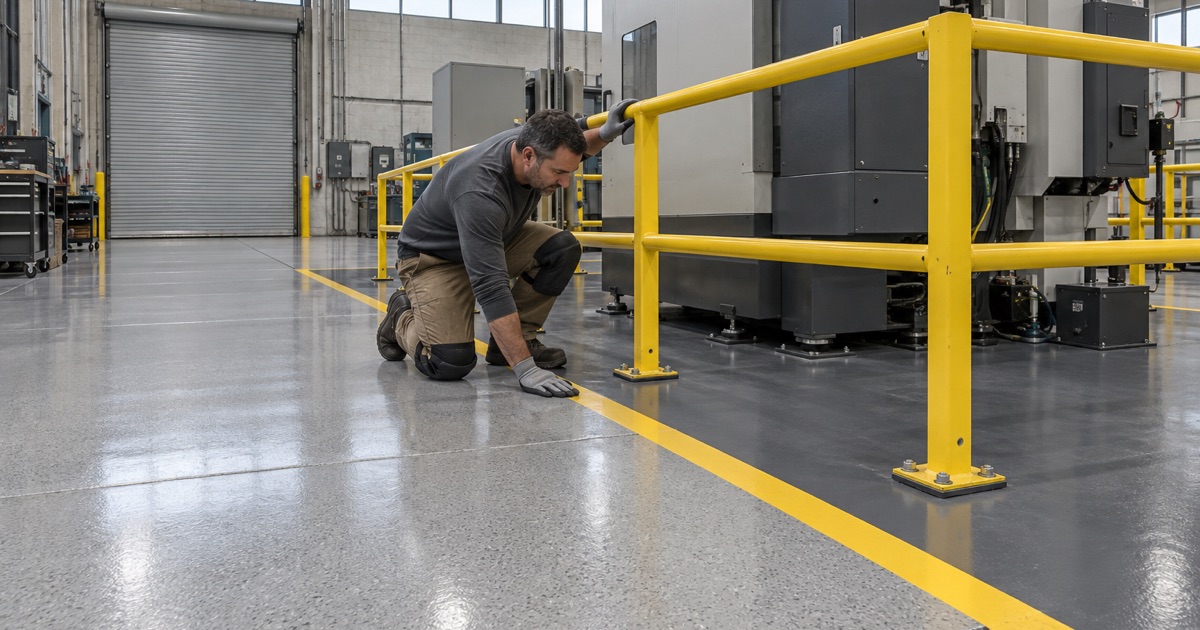
Shot Blasting and Heavy Grinding
Industrial slabs are usually shot blasted or ground with aggressive diamond tooling to create the rougher ICRI concrete surface profile that thick, high-build systems need. Shot blasting covers large open areas quickly, while grinders handle the edges, around machine bases and in tight spaces.
Dust is captured at each machine by an industrial vacuum, keeping it away from equipment, stock and the rest of the plant. Grinding dust is never washed toward a floor drain or storm inlet.
Oil, Coolant and Hydraulic Fluid Contamination
Years of oil, coolant and hydraulic fluid can soak deep into concrete and keep wicking back to the surface after grinding, which prevents a coating from bonding. Contaminated areas are degreased, ground or blasted, and treated with a specialty primer where the residue cannot be fully removed.
In the worst cases, the soaked concrete has to be cut out and patched with a repair mortar. We identify those areas during the slab walk so they are priced and scheduled rather than discovered halfway through the job.
Joint and Impact Repair
Joints at forklift and pallet jack crossings often spall along the edges, and dropped parts leave gouges in high-traffic areas. Spalled joints and damaged areas are cut back to sound concrete and rebuilt with an epoxy mortar or high-strength repair material.
Joints that still move are filled with a semi-rigid filler that supports wheel traffic without cracking, so the edges stay protected after the coating goes down. Where a slab has heaved or settled, we say so before quoting rather than coating over it.
Industrial Floor Systems
High-Build Epoxy
High-build 100% solids epoxy systems are applied in thicker layers than residential coatings, giving more protection against impact and abrasion. They resist many oils, fuels and industrial chemicals, and they can be textured with a quartz or aggregate broadcast for slip resistance.
The proposal names the product line, each coat and the finished thickness, so the floor can be checked against the quote. Where a specification calls for it, pull-off adhesion testing under ASTM D4541 confirms the bond.
Epoxy Mortar and Trowel-Applied Systems
For areas with the heaviest impact, such as loading zones and spots where heavy parts are dropped, troweled epoxy mortar systems give a thick, very tough surface. They can also rebuild a worn or uneven slab in the same step.
These systems take longer and cost more than a rolled coating, so we use them where the floor actually needs them. A plant might have mortar in the loading area and a high-build coating in assembly.
Urethane Cement for Heat and Wash-Down
Where floors see hot water, steam cleaning, thermal shock or aggressive cleaning agents, standard epoxy softens and fails. Urethane cement handles those conditions far better and can be installed with an integral cove base where walls meet the floor.
It is the standard choice for food processing and wash-down areas. In a mixed facility, urethane cement often covers the wet process areas while epoxy covers dry storage and assembly.
Safety, Striping and Layout
Slip Resistance in Wet and Oily Areas
Industrial floors near machines, wash stations and loading doors get wet, oily or both. Slip resistance is specified through the broadcast aggregate and topcoat build, with coarser texture where fluids land and smoother finishes where carts and pallet jacks roll.
The proposal states the texture for each area, so it can be checked after installation rather than taken on faith. Too much texture makes cleaning harder, so we balance grip and cleanability by zone.
Aisle Striping and Safety Zones
Forklift aisles, pedestrian walkways, staging areas and safety zones around equipment can be marked with striping applied as part of the floor system. Color-coded zones help crews follow traffic patterns and keep walkways clear.
Striping is laid out with you before installation, so it matches the way the plant actually operates rather than a generic layout. It goes down as part of the coating system, under or within the topcoat, so forklift wheels do not wear it off the way painted lines on bare concrete wear away.
Working Around Production
Phasing by Area and Shift
Plants that cannot stop are coated in phases, with each area prepped and coated during a shutdown, overnight or over a weekend. Fast-curing materials shorten the time each area is out of service.
The phase plan, cure times and return-to-service dates are written into the proposal. We coordinate with your maintenance and production managers so equipment moves and shutdowns are planned in advance.
Moisture Testing and Warranty
Industrial slabs are moisture tested before pricing, and slabs on grade with no vapor retarder can carry more moisture than expected. The readings decide whether a moisture-mitigation primer belongs in the system.
Warranty exclusions, starting with moisture vapor transmission and hydrostatic pressure, are explained before the job is sold. That keeps the coverage clear on a floor where a failure would mean downtime.
Shops, Service Bays and Fabrication Floors
Farm Shops and Equipment Dealer Service Bays
Farm shops and equipment dealer service bays handle mud, hydraulic fluid, grease and heavy machines coming in from the field. A coated floor makes leaks easy to spot and clean up, brightens the shop by reflecting light, and keeps fluids from soaking into the concrete.
Many shop slabs were poured without a vapor retarder, so the moisture test matters here as much as in any basement. Tracks, lugs and dropped implements call for a thicker build than a garage system, and the texture is set for footing around wash areas.
Warehouse Racking and Dock Areas
Warehouse floors under racking see point loads from rack feet and constant pallet jack turns at the aisle ends, while dock areas take the brunt of winter slush, salt and tire grit carried in from trailers. Those zones wear first, so they get the thickest build and the most attention to joint edges.
Rack layouts are planned with you before installation, since coating under existing racking means working around anchored uprights. Where racks will be moved or added later, we coat the full floor first and stripe the aisles once the layout is set.
- 20+ Years on Iowa Concrete
- Moisture Tested in Writing
- Free Estimates