
Ames Epoxy Flooring handles concrete floor repair in Ames, IA, serving surrounding cities including Nevada, Polk City, Huxley, Ankeny and Boone. Cracks, spalls, pitting, scaling and broken joints are the most common reasons a slab looks worn out, and they are also the most common reason a floor coating fails early. A coating laid over damaged concrete simply follows the damage, cracking where the slab cracks and lifting where the surface is weak.
That is why every floor we coat is mapped before it is priced. Cracks, spalls, joints and old coatings are marked and measured, the repair plan is written into the proposal, and we tell you plainly when a slab needs repair or replacement before it should be coated. With more than twenty years on central Iowa concrete, we have learned which damage repairs well and which keeps coming back.
Crack Repair
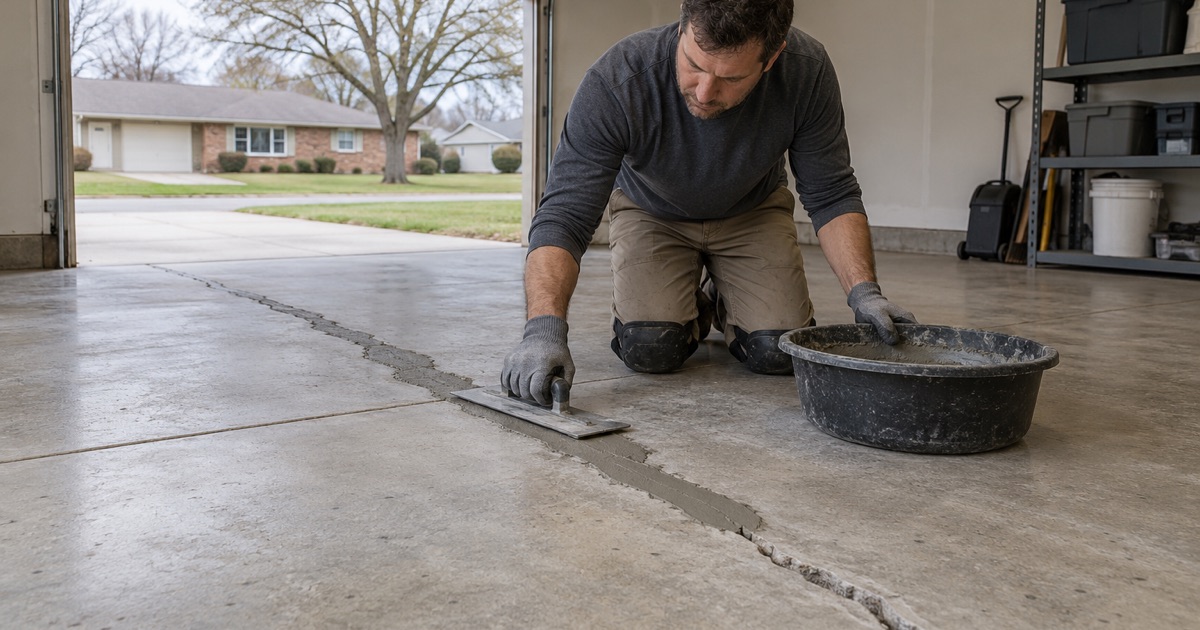
Dormant Cracks
Most slabs crack as concrete shrinks while it cures, and many of those cracks stop moving within the first years. Dormant cracks are routed or ground open, cleaned, and filled with a rigid epoxy or polyurea repair material, then ground flush with the floor.
Once coated, a properly repaired dormant crack usually disappears from view. On bare or polished concrete, the fill stays visible as a line, which some owners like and others hide with a color-matched filler.
Moving Cracks and Control Joints
Cracks that open and close with temperature or slab movement will break a rigid repair and reappear through any coating laid over it. Those cracks are filled with a semi-rigid or flexible material that can move with the slab, or treated as a joint in the finished floor.
Control joints are designed to crack, and they keep moving for the life of the slab. We fill them with a semi-rigid joint filler where traffic needs a flush surface, or honor them as clean lines in the coating where that makes more sense.
Settlement and Structural Cracking
Wide cracks with one side higher than the other often point to settlement, frost movement or soil problems under the slab. Filling them hides the symptom without fixing the cause, and the crack will usually shift again.
When we see that kind of cracking, we tell you before quoting a coating. Depending on the extent, the honest recommendation may be to replace the affected section rather than repair it.
Spalls, Pitting and Popouts
Spalled Edges and Joint Damage
Spalls are chips and broken edges, most often along joints, cracks and slab edges where wheels and impacts concentrate. They are cut back to sound concrete, cleaned and rebuilt with an epoxy mortar or a polymer-modified repair material.
In garages, spalls often appear at the door threshold and along the joint where the driveway meets the slab. In warehouses and shops, forklift and pallet jack wheels chip the edges of joints at crossings, and those repairs are paired with joint filler so the damage does not return.
Pitting and Popouts
Pitting and popouts are small craters where aggregate or the surface paste has broken away. They are common on older garage slabs and on concrete that was finished with too much water at the surface.
We fill pits and popouts with a repair compound and grind them flush so they do not telegraph through a coating. On a flake floor, small pits are hidden easily; on a metallic or solid color finish, more careful filling is needed.
Impact Damage in Shops and Plants
Dropped parts, dragged equipment and heavy machinery leave gouges and broken areas in shop and plant floors. Those are cut out and rebuilt with a high-strength repair mortar that can take the same kind of loads as the original concrete.
Where a business has to stay open, we use fast-setting repair materials and phase the work around shifts. The repaired area can often return to light traffic the same day.
Freeze-Thaw Scaling
What Causes Scaling on Iowa Garage Slabs
Scaling is the flaking and peeling of the top layer of concrete, and in Iowa it is driven mainly by freeze-thaw cycles in concrete soaked with water and deicer brine. Calcium chloride and rock salt ride into the garage on tires, melt the snow that comes with them, and soak into the slab, where the water freezes and thaws within the surface.
Scaling usually starts near the garage door and in the wheel paths, where snowmelt pools and refreezes. Over several winters, it spreads and deepens if the slab is left bare.
Rebuilding Scaled Areas
Scaled concrete is ground back until sound material is reached, then rebuilt with a repair mortar or a thicker epoxy fill so the surface is level again. Only then does a coating go on, sealing the repaired slab against the brine that caused the damage.
If scaling has spread across most of the floor and gone deep, the remaining concrete may be too weak to support a coating. In that case, we discuss replacing the slab instead.
Repairs Before a Coating or Polish
Mapping Damage Before Pricing
Every repair is marked on the slab during our first visit and listed in the proposal, with a separate line for each type of work. That way, the cost of repair is clear and is not hidden inside a single floor price.
Mapping also lets us flag slabs that should not be coated at all. Telling you that early saves you from paying for a finish that will crack along the same lines within a season or two.
Matching the Repair to the Finish
The repair material is chosen with the final finish in mind. Under a flake or quartz coating, a fast-setting epoxy or polyurea fill ground flush disappears completely, while under a metallic or solid color finish the fill needs more careful feathering so it does not show as a shadow.
On polished concrete, repairs stay part of the visible floor, so a color-matched filler or a grout coat during grinding keeps them from standing out. We show you how a repair will read in your chosen finish before the work begins.
Moisture Checks Around Repairs
Cracks and joints are common paths for moisture to come up through a slab, especially in basements. A repair can close the surface, but if water is moving through the crack from below, the new coating may still blister around it.
That is why the moisture test is part of every repair scope, not only coating jobs. Where readings are high, we add a moisture-mitigation primer or recommend solving the drainage problem before any finish goes over the repaired slab.
- 20+ Years on Iowa Concrete
- Moisture Tested in Writing
- Free Estimates