Ames Epoxy Flooring installs commercial kitchen flooring in Ames, IA, serving surrounding cities including Ankeny, Boone, Huxley, Polk City and Nevada. A restaurant or institutional kitchen is one of the hardest places a floor can work: hot water and steam during cleanup, grease and food acids during service, dropped pans, rolling carts, and a crew on its feet in wet conditions for hours at a time. Tile and grout break down under that, and a thin coating softens and peels.
Kitchen floors need a seamless, chemical-resistant system that runs up the wall as an integral cove, slopes to the drains, and grips underfoot when it is wet. With more than twenty years on central Iowa concrete, we build them on a ground, repaired and moisture-tested slab, and we plan the work around the kitchen’s schedule so service is interrupted as little as possible.
The Rules a Kitchen Floor Has to Meet
The Food Code in Iowa
Iowa adopted the 2017 FDA Food Code through 481 IAC 31, and it sets the baseline for kitchen floors. Floors must be smooth, durable and easily cleanable, and nonabsorbent where they get wet. Under section 6-201.13, floor and wall junctures in many areas must be coved and closed, so no gap is left where food debris and water can collect.
Section 6-201.11 adds an exception for antislip floor surfaces in areas where safety calls for them. That lets a kitchen floor carry a textured, slip-resistant finish while still meeting the cleanable-floor rule.
Inspections in Story County
Food establishments in Story County are inspected by the Iowa Department of Inspections, Appeals, and Licensing, which works directly from the state rules. An inspector looks at whether floors are intact, cleanable and coved where required, and whether water pools anywhere it should drain.
Building the floor to those rules from the start avoids problems at inspection. We review the layout with you and your designer before the job to confirm which areas need cove and texture.
City of Ames Kitchen Requirements
The City of Ames inspections guidance for commercial kitchens calls for a floor drain, with the floor sloped toward it, and floor drains routed to an approved grease interceptor. Those drains and the interceptor are plumbing work, but the floor has to meet them correctly.
We slope and finish the coating cleanly into each drain body so water runs off rather than pooling around equipment. Drains and cleanouts stay fully accessible for service.
Kitchen Floor Systems
Urethane Cement
Urethane cement is the standard for working kitchens. It handles hot water, steam cleaning, thermal shock from boiling liquids, grease and food acids that soften epoxy over time. It also tolerates more moisture in the slab than most epoxies, which helps on older kitchen slabs.
It is typically troweled or applied as a thick slurry with a quartz broadcast for texture, then topcoated. The proposal names the product line, each layer and the finished thickness.
Integral Cove Base
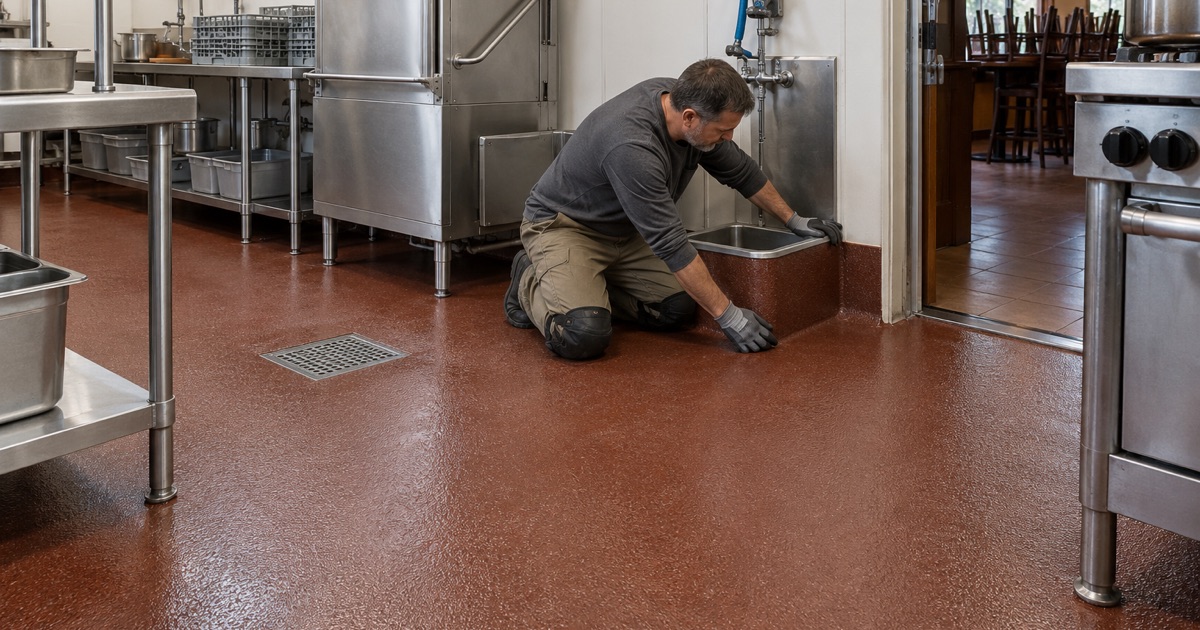
The floor system is carried up the wall in a smooth curve, forming an integral cove base with no seam where floor meets wall. That curve is what the Food Code means by a coved juncture, and it is far easier to clean than a separate base strip.
Cove height and detail are set before the job, along with how the cove meets door frames, equipment bases and existing wall finishes. It is built from the same system as the floor so it cleans the same way.
Epoxy for Dry and Front-of-House Areas
Not every room in a food business needs urethane cement. Dry storage, offices, restrooms and some front-of-house areas can use an epoxy or flake system, which gives more color and finish options at a lower cost.
We split the building by use, so each area gets the system it actually needs. The proposal shows which areas get which system and where the transitions fall.
Slip Resistance and Cleaning
Texture for Wet and Greasy Floors
Slip resistance in a kitchen comes from the broadcast aggregate and the topcoat. A quartz broadcast locked into the system gives a textured surface that grips when the floor is wet or greasy, and the amount of texture is specified rather than promised.
More texture means better grip but slightly more effort to clean. We set the texture by zone, with the most grip at the dish area, fryers and cook line, and a slightly smoother finish in prep and storage areas.
Cleaning a Seamless Floor
A seamless urethane cement floor can be cleaned with hot water and the degreasers and sanitizers kitchens use every day. With no grout lines, there is nowhere for grease and bacteria to settle, and the cove makes the wall line easy to scrub.
We provide care guidance for your cleaning crew, including deck brushes for textured floors and which cleaners suit the system. A stiff brush reaches into the texture where a mop slides over it, which keeps the grip working.
Planning a Kitchen Floor Project
Removing Old Tile and Repairing the Slab
Most kitchen projects start by removing failing quarry tile, old coatings or vinyl down to the slab. Damaged concrete, uneven areas and drain surrounds are repaired, and the slab is ground or shot blasted to a profile the new system can grip.
Old slabs often hide soft or grease-soaked concrete under the tile. We assess it as soon as the covering comes up and tell you plainly if any area needs replacing.
Scheduling Around Service
Kitchens cannot close for long. Work is phased and scheduled overnight or around closure days, and fast-curing urethane cement systems shorten the time an area is out of service.
The proposal lists each phase, which equipment must be moved, and when the floor can take foot traffic and equipment again. We coordinate with your equipment and plumbing contractors so the floor is ready when they return.
- 20+ Years on Iowa Concrete
- Moisture Tested in Writing
- Free Estimates